I’m a Basket Case
There are seasons when the most important thing God can do for you is make sure nobody notices you. That sounds strange because most of us have been trained to interpret recognition as confirmation. If people see you, celebrate you, invite you, mention you, and make room for you, you assume you must be important. If nobody is paying attention, you begin wondering whether you have somehow been overlooked.
Moses begins his life by teaching us that obscurity is not always rejection. Sometimes obscurity is protection, and sometimes being hidden is evidence that something valuable is being preserved. Moses was born valuable in an environment that had become dangerous to anything valuable. Before he could understand the world around him, the world had already decided that someone like him should not survive.
Pharaoh had commanded that Hebrew sons be killed, so Moses entered the world carrying potential that his environment had already decided it could not tolerate. Before he could speak, walk, fight, lead, or perform a miracle, his existence was already considered a threat. He did not know who was against him, and he could not understand the political climate surrounding his birth. He did not know there were people who would have destroyed him simply for being discovered.
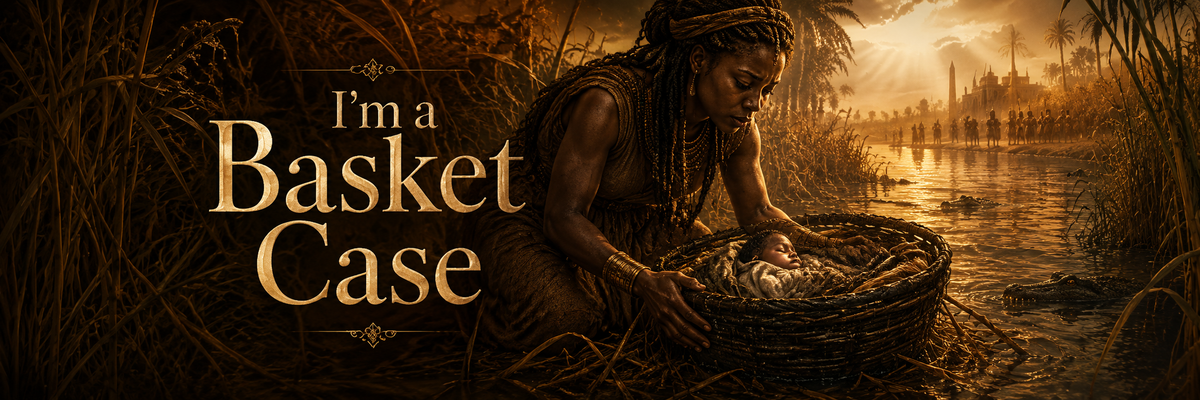
His mother understood everything that Moses was too young to understand, so she built him a basket. There is something almost insulting about the material she used to protect something so precious. Exodus tells us that the vessel was made from bulrushes and covered with slime and pitch. Moses was valuable, but his container did not look valuable.
The future deliverer of Israel was surrounded by mud, reeds, swamp vegetation, and the residue of a riverbank. He looked like something nobody should bother investigating, and that was part of the wisdom of the strategy. His mother understood that there are moments when looking ordinary is safer than looking important. Moses did not survive because everybody recognized his greatness; he survived because the things around him made his greatness difficult to recognize.
The basket functioned as camouflage, and that is an important lesson for anyone frustrated by an environment that does not seem to reflect what is inside them. There are things God allows around you that do not seem consistent with what He put within you. You know there is more in you, but your surroundings do not advertise it. Your environment may look too small, your opportunities may look too ordinary, and your present position may appear far beneath your potential.
That does not necessarily mean you are in the wrong place. Sometimes God deliberately allows treasure to travel in unimpressive packaging because predators are attracted to obvious value. Everything precious does not need to announce itself while it is still vulnerable. There are seasons when survival requires your significance to remain concealed.
The Nile was not a safe nursery, and Moses was placed into water inhabited by creatures capable of consuming him. On land were Egyptians who could kill him if they discovered him, while beneath the water were predators that could destroy him if they reached him. Moses was suspended between dangers he did not have the strength to fight. He survived because the basket prevented everything around him from having direct access to him.
That is one of the clearest pictures of divine hiding in the story. God does not always protect you by removing predators from your environment. Sometimes He protects you by controlling their access to you. The crocodile can remain in the water, Pharaoh can remain in the palace, and the threat can remain completely real while God still prevents the threat from reaching what He has decided to preserve.
That changes the meaning of seasons when nobody seems to recognize you. Perhaps you are not being ignored as much as you are being concealed. Perhaps the silence around your name is not evidence that heaven has forgotten you. Perhaps heaven knows that premature visibility would expose you to things you are not yet supposed to fight.
The painful part is that hiding rarely feels like protection while you are inside it. Moses could not see his mother's reasoning, and from inside the basket all he could experience was separation. The woman who loved him had placed him somewhere that could easily have felt like abandonment. The person responsible for his safety had apparently released him into uncertainty.
What looked like abandonment, however, was actually one of the most sophisticated expressions of her protection. She loved him enough to release him into something she had carefully prepared. Moses was not being thrown away; he was being hidden inside a structure designed to carry him through danger. His mother could not remove every threat, but she could create something between her son and the things that wanted to consume him.
Some of the environments that make you question whether you have been forgotten may actually be engineered to preserve you until you reach the right hands. You may be looking at the mud around your basket and assuming that your surroundings are describing your value. They are not, because the quality of the container does not determine the value of what it carries. Sometimes the mud is there precisely because something expensive needs to travel without looking expensive.
You do not display diamonds in the window when thieves are outside. You conceal them because their value creates the very reason they need protection. Moses was hidden because Egypt did not yet understand what was inside that basket. The people who might have destroyed him could not attack what they could not accurately identify.
Inside those reeds was a future confrontation with Pharaoh. Inside that mud was the man who would stand at the Red Sea and stretch out his hand. Inside that little vessel was legislation, liberation, leadership, miracles, commandments, and a nation learning how to walk with God. Egypt may have seen a basket floating among reeds, but God saw everything Moses would eventually become.
That is why you cannot allow a lack of recognition to convince you that you lack significance. Visibility and value are not the same thing, and sometimes your value is precisely why God has restricted your visibility. Everything valuable does not need to be exposed immediately. There is a time to be seen, and there is also a time when being unseen is part of your survival.
Moses eventually came out of the basket, entered the palace, stood before Pharaoh, and became impossible to ignore. Before God made him visible, however, God allowed him to be hidden. Before Moses became a public deliverer, he was a concealed infant floating through dangerous water. His first victory was not defeating Pharaoh; his first victory was surviving long enough to become the man who could face him.
So if this season feels like mud, reeds, uncertainty, silence, and limited recognition, do not automatically assume something has gone wrong. You may be experiencing the strange protection of a basket, where your environment looks smaller than your destiny because your destiny is still being preserved. God may be allowing you to remain unseen because there are predators nearby that do not need to know what you are carrying yet. If God has taken the trouble to hide you, it may be because there is something inside you that He intends to protect until the proper time for you to be revealed.