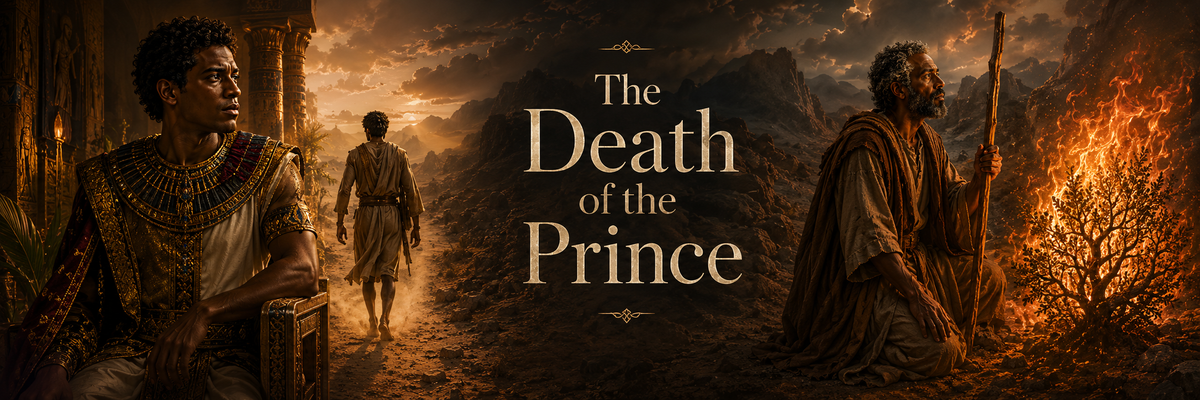
The Prince had to die so the Prophet could live
An important detail of personal development, which profoundly impacts us as people, is that there are processes and events in life that work in between our present reality and our appointed time with destiny. Before Moses could become the prophet who confronted Pharaoh, divided the sea, and carried a nation toward freedom, he served as a prince in Egypt. Exodus 1:1-10 details his origin and his youth in the family of Pharoah. Yet, Exodus 2:11-25 details him leaving the royal family as a fugitive. God's purpose in this experience was simple: the prince he had become had to die in order for the prophet he needed to become to live.
Moses was born under a death sentence, hidden in a basket, discovered by Pharaoh’s daughter, and raised inside the very system that was oppressing his people. His survival depended on conformity to Egypt. He learned how to move between worlds: He was Hebrew by blood but Egyptian by education. He knew the language of the enslaved and the customs of the palace. He understood suffering from a distance but privilege from the inside.
The palace taught Moses how power worked. It gave him access, knowledge, refinement, and proximity to authority. Yet, it also created an identity that could not fulfill his assignment.
Moses the prince believed that because he recognized injustice, he was ready to correct it. When he saw an Egyptian beating a Hebrew, he looked in every direction, killed the Egyptian, and buried him in the sand. His intentions may have been connected to justice, but his method was still shaped by Egypt. If you remember (Gen 40:20-22), we have the record stating that it was Pharaoh of Joseph's day who killed the butler in the story of Joseph because Pharoah was displeased with his service. If we examine the entirety of Genesis, we find no logical reason for the baker to be killed other than it being the desire of the Pharoah. Even in Ancient Egypt, in Africa, an African is not free from the injustices of the system.
This tells you of the history of how people of power related to subjects in Egyptian culture and how there was a history of class supremacy in Egypt, where they would frivilously delete the workers as they chose with no sign of due process, probable cause or equitable fairness. This pattern of oppression is much like the actions of Moses. Moses, as a prince of Egypt, could have commanded the soldier in Exodus 2 to stop beating the slave but instead chose to take the law into his own hands and kill the soldier. (This would be a mistake he repeats with Israel that cost him his entrance to the promised land. God commands him to speak, and he breaks away from the command of God to do violence by hitting the stone instead of speaking to it. Moses did to the rock what he did to the solider in Egypt. [Ex 17:1-7]) Here, we see Moses doing to the Egyptian what the pharaoh in Joseph's day did to one of his servants who was a baker. When Pharoah was displeased with the service of his servants, he tried to solve his irritation of oppression with secrecy, force, personal calculation, and ruthless execution of irritants. There is no pause for due process. Moses is infected with the groupthink of Egypt that says people are less human than you because they were not born to your group.
Notice that he looks around before he kills the Egyptian in Exodus 2. He believed that if he could eliminate the irritant and conceal the evidence, he could manage the consequences. This is the second aspect of princely behavior that God wants to address. The prince thought that he was above the law. The prophet God needed has to not only give the law but also show people how to be governed. The Bible does not redact the misdeeds of Moses, and God allows the community to discover his wrongdoing. This plan backfires, as the Divine God would not suffer destiny to be built through anarchy, hidden violence, and concealed wickedness.
When his actions were exposed, Moses fled. That flight was not merely an escape from Pharaoh. It was the funeral procession of the prince. In Midian, Moses lost his title, position, influence, and familiarity. The man who had once lived among royalty became a shepherd in the wilderness. He moved from commanding from a position to paying attention to tending to animals. He went from the architecture of empire to the silence of open land.
The wilderness did not destroy Moses. It stripped him of the identity that would have destroyed his calling. Moses the prince was impulsive. Moses the prophet became observant. The prince acted before being sent or being decent. The prophet learned to wait in the desert for instruction. The prince tried to rescue one man through his own strength. The prophet returned to deliver an entire nation through the power of God.
The palace had taught Moses strategy, but the wilderness taught him sensitivity. He learned how to notice movement in lonely places. He recognized a bush that burned without being consumed because years of obscurity had trained him to pay attention. He had learned to be observant, not because he was about to execute vigilante justice, but because the death of the prince gave Moses the patience to be observant. God did not call Moses while Moses was trying to be impressive. God called him while he was faithfully managing what appeared insignificant.
The prince had to die because the prophet could not depend on prestige. The deliverer could not be addicted to recognition. The Israelites needed leadership that was not contaminated with the brutality of Egypt. The man chosen to challenge Pharaoh had to become comfortable surviving without Pharaoh’s approval or the belief that his association with power made him greater than the law he served.
Sometimes the collapse of an identity is not the end of your purpose. It is the beginning of your preparation. Moses lost the palace, but he found his voice. He lost his position, but he discovered his assignment. He lost the life he had constructed, but he became the man his story and history required. The prince was buried in Midian so the prophet could rise at the burning bush. Likewise, as we allow ourselves to be transformed through the transitions, trials, and tests of life, our princes are dying in deserts so that our dependency can be on God. Our result will be that we transitioned into what God needs us to be for our God-given assignments as people of God.